Publications by Topic
Edited Volumes
Machine Learning and Programming Languages
Semantics-aware Program Sampling (2017)
Pratiksha Thaker,
Daniel Tarlow,
Marc Brockschmidt, and
Alex Gaunt.
NIPS Workshop on Discrete Structures in Machine Learning (DISCML 2017).
[
pdf]
Learning Shape Analysis (2017)
Marc Brockschmidt,
Yuxin Chen,
Pushmeet Kohli,
Siddharth Krishna,
and Daniel Tarlow.
Proceedings of the 24th Static Analysis Symposium (SAS 2017).
[
pdf]
AMPNet: Asynchronous Model-Parallel Training for Dynamic Neural Networks (2017)
Alex Gaunt,
Matthew Johnson,
Maik Riechert,
Daniel Tarlow,
Ryota Tomioka,
Dimitrios Vytiniotis,
and Sam Webster.
[
arxiv]
Differentiable Programs with Neural Libraries (2017)
Alex Gaunt,
Marc Brockschmidt,
Nate Kushman,
and Daniel Tarlow.
International Conference on Machine Learning (ICML 2017).
(Conference version of "Lifelong Perceptual Programming by Example" from ICLR 2017 Workshop).
[
arxiv]
DeepCoder: Learning to Write Programs (2017)
Matej Balog,
Alex Gaunt,
Marc Brockschmidt,
Sebastian Nowozin,
and Daniel Tarlow.
International Conference on Learning Representations (ICLR 2017).
[
preprint]
Neural Program Lattices (2017)
Chengtao Li,
Daniel Tarlow,
Alex Gaunt,
Marc Brockschmidt,
and
Nate Kushman.
International Conference on Learning Representations (ICLR 2017).
[
preprint]
Neural Functional Programming (2017)
John Feser,
Marc Brockschmidt,
Alex Gaunt,
and Daniel Tarlow.
Workshop Track at International Conference on Learning Representations (ICLR 2017).
[
preprint]
TerpreT: A Probabilistic Programming Language for Program Induction (2016)
Alex Gaunt,
Marc Brockschmidt,
Rishabh Singh,
Nate Kushman,
Pushmeet Kohli,
Jonathan Taylor,
and Daniel Tarlow.
Short version at
NIPS Workshop on Neural Abstract Machines and Program Induction (NAMPI 2016).
Best Paper Award
[
arXiv long version]
Learning to Verify the Heap (2016)
Marc Brockschmidt,
Yuxin Chen,
Byron Cook,
Pushmeet Kohli,
Siddharth Krishna,
Daniel Tarlow, and
He Zhu.
[
preprint]
Gated Graph Sequence Neural Networks (2016)
Yujia Li,
Daniel Tarlow,
Marc Brockschmidt, and
Richard Zemel.
International Conference on Learning Representations (ICLR 2016).
[
arXiv]
[
code]
Learning to Decipher the Heap for Program Verification (2015)
Marc Brockschmidt,
Yuxin Chen,
Byron Cook,
Pushmeet Kohli, and
Daniel Tarlow.
Workshop on Constructive Machine Learning at ICML 2015.
Best Paper Award
[
pdf]
Bimodal Modelling of Source Code and Natural Language (2015)
Miltos Allamanis,
Daniel Tarlow,
Andrew D. Gordon, and
Yi Wei.
The 32nd International Conference on Machine Learning (ICML 2015)
.
[
pdf]
Probabilistic Programs as Spreadsheet Queries (2015)
Andrew D. Gordon,
Claudio Russo,
Marcin Szymczak,
Johannes Borgstrom,
Nicolas Rolland,
Thore Graepel, and Daniel Tarlow.
European Symposium on Programming (ESOP 2015).
[
http]
[
tech report version]
Structured Generative Models of Natural Source Code (2014)
Chris Maddison and
Daniel Tarlow.
The 31st International Conference on Machine Learning (ICML 2014).
[
pdf]
[
appendix]
Probabilistic Inference
Consensus Message Passing for Layered Graphical Models
(2015)
Varun Jampani*,
S. M. Ali Eslami*,
Daniel Tarlow,
Pushmeet Kohli, and
John Winn.
The 18th International Conference on Artificial Intelligence and Statistics (AISTATS 2015).
*Equal contribution.
[
pdf]
[
arXiv version]
A* Sampling
(2014)
Chris Maddison,
Daniel Tarlow, and
Tom Minka.
Advances in Neural Information Processing Systems (NIPS 2014).
Oral Presentation,
Outstanding Paper Award
[
pdf] [
appendix]
Just-In-Time Learning for Fast and Flexible Inference
(2014)
S. M. Ali Eslami,
Daniel Tarlow,
Pushmeet Kohli, and
John Winn.
Advances in Neural Information Processing Systems (NIPS 2014).
[
pdf] [
appendix]
Learning to Pass Expectation Propagation Messages
(2013)
Nicolas Heess,
Daniel Tarlow, and
John Winn.
Advances in Neural Information Processing Systems (NIPS 2013).
[
pdf]
Tighter Linear Program Relaxations for High Order Graphical Models (2013)
Elad Mezuman*,
Daniel Tarlow*,
Amir Globerson, and
Yair Weiss.
The 29th Conference on Uncertainty in Artificial Intelligence (UAI 2013).
*Equal contribution.
[
pdf]
[
bibtex]
Fast Exact Inference for Recursive Cardinality Models (2012)
Daniel Tarlow,
Kevin Swersky,
Richard Zemel,
Ryan Adams, and
Brendan Frey.
The 28th Conference on Uncertainty in Artificial Intelligence (UAI 2012).
[
pdf + appendix] [
code]
[
bibtex]
Graph Cuts is a Max-Product Algorithm (2011)
Daniel Tarlow,
Inmar Givoni,
Richard Zemel, and
Brendan Frey.
The 27th Conference on Uncertainty in Artificial Intelligence (UAI 2011).
Oral Presentation,
Best Student Paper Award - Runner Up
[
pdf] [
arXiv version]
[
bibtex]
Dynamic Tree Block Coordinate Ascent (2011)
Daniel Tarlow,
Dhruv Batra,
Pushmeet Kohli, and
Vladimir Kolmogorov.
The 28th International Conference on Machine Learning (ICML 2011).
[
pdf]
[
code at Dhruv's page]
[
bibtex]
HOP-MAP: Efficient Message Passing with High Order Potentials (2010)
Daniel Tarlow,
Inmar Givoni, and
Richard Zemel.
The 13th International Conference on Artificial Intelligence and Statistics (AISTATS 2010)
[
pdf]
[
code]
[
bibtex]
Flexible Priors for Exemplar-based Clustering (2008)
Daniel Tarlow,
Richard Zemel, and
Brendan Frey.
The 24th Conference on Uncertainty in Artificial Intelligence (UAI 2008).
Oral Presentation
[
pdf]
[
bibtex]
Using Combinatorial Optimization within Max-Product Belief Propagation (2006)
John Duchi,
Daniel Tarlow,
Gal Elidan, and
Daphne Koller.
Advances in Neural Information Processing Systems (NIPS 2006).
Spotlight Presentation
[pdf]
[bibtex]
Structured Prediction
Factorizing Shortest Paths with Randomized Optimum Models (2016)
Daniel Tarlow,
Alexander Gaunt,
Ryan Adams, and
Richard Zemel.
In
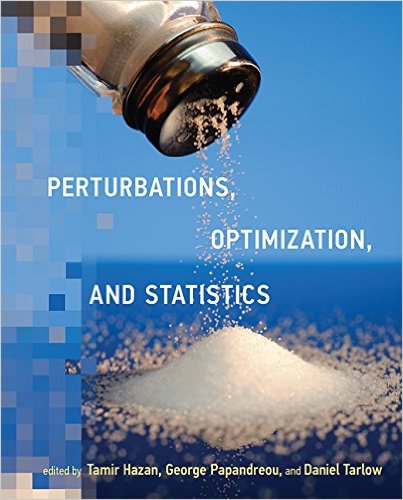
Perturbations, Optimization, and Statistics.
Tamir Hazan, George Papandreou, Daniel Tarlow (Eds.). MIT Press.
[pdf coming soon]
Empirical Minimum Bayes Risk Prediction (2016)
Vittal Premachandran,
Daniel Tarlow,
Alan Yuille, and
Dhruv Batra.
Transactions on Pattern Analysis and Machine Intelligence (TPAMI 2016)
.
[pdf coming soon]
Optimizing Expected Intersection-over-Union with Candidate-Constrained CRFs
(2015)
Faruk Ahmed,
Daniel Tarlow, and
Dhruv Batra.
International Conference on Computer Vision (ICCV 2015).
[
pdf]
Minimizing Expected Losses in Perturbation Models with Multidimensional Parametric Min-cuts
(2015)
Adrian Kim,
Kyomin Jung,
Yongsub Lim,
Daniel Tarlow, and
Pushmeet Kohli.
The 31st Conference on Uncertainty in Artificial Intelligence (UAI 2015).
Oral Presentation
[
pdf]
Empirical Minimum Bayes Risk Prediction: How to extract an extra few % performance from vision models with just three more parameters (2014)
Vittal Premachandran,
Daniel Tarlow, and
Dhruv Batra.
The 27th IEEE Conference on Computer Vision and Pattern Recognition (CVPR 2014).
[
pdf] [
project]
Learning Structured Models with the AUC Loss and Its Generalizations
(2014)
Nir Rosenfeld,
Ofer Meshi,
Daniel Tarlow, and
Amir Globerson.
The 17th International Conference on Artificial Intelligence and Statistics (AISTATS 2014).
[
pdf]
[
appendix]
Exploring Compositional High Order Pattern Potentials for Structured Output
Learning
(2013)
Yujia Li,
Daniel Tarlow, and
Richard Zemel.
The 26th IEEE Conference on Computer Vision and Pattern Recognition (CVPR 2013).
Oral Presentation
[
pdf]
[
appendix]
[
bibtex]
Probabilistic n-Choose-k Models for Classification and Ranking (2012)
Kevin Swersky,
Daniel Tarlow,
Ryan Adams,
Richard Zemel, and
Brendan Frey.
Advances in Neural Information Processing Systems (NIPS 2012).
[
pdf]
[
appendix]
[
bibtex]
Revisiting Uncertainty in Graph Cut Solutions (2012)
Daniel Tarlow and
Ryan Adams.
The 25th IEEE Conference on Computer Vision and Pattern Recognition (CVPR 2012).
[
pdf + appendix]
[
bibtex]
Randomized Optimum Models for Structured Prediction (2012)
Daniel Tarlow,
Ryan Adams, and
Richard Zemel.
The 15th International Conference on Artificial Intelligence and Statistics (AISTATS 2012).
[
pdf + appendix]
[
bibtex]
Structured Output Learning with High Order Loss Functions (2012)
Daniel Tarlow and
Richard Zemel.
The 15th International Conference on Artificial Intelligence and Statistics (AISTATS 2012).
[
pdf + appendix]
[
bibtex]
Big and Tall: Large Margin Learning with High Order Losses (2011)
Daniel Tarlow and
Richard Zemel.
CVPR 2011 Workshop on Inference in Graphical Models with Structured Potentials.
[
pdf]
[
bibtex]
Other Models and Applications
Training Continuous-time Spiking Neural Networks with Back-propagation Through Spike Times (2018).
David Sussillo,
Chris Maddison,
Matt Johnson, and
Daniel Tarlow.
Computational and Systems Neuroscience (COSYNE 2018).
[pdf coming soon]
Batch Policy Gradient Methods for Improving Neural Conversation Models (2017)
Kirthevasan Kandasamy,
Yoram Bachrach,
Ryota Tomioka,
Daniel Tarlow,
and
David Carter.
International Conference on Learning Representations (ICLR 2017).
[
preprint]
Fits Like a Glove: Rapid and Reliable Hand Shape Personalization (2016)
David Joseph Tan,
Thomas Cashman,
Jonathan Taylor,
Andrew Fitzgibbon,
Daniel Tarlow,
Sameh Khamis,
Shahram Izadi, and
Jamie Shotton.
Computer Vision and Pattern Recognition (CVPR 2016).
[
pdf]
Knowing what we don't know in NCAA Football ratings: Understanding and using structured uncertainty (2014)
Daniel Tarlow,
Thore Graepel, and
Tom Minka.
The 2014 MIT Sloan Sports Analytics Conference (SSAC 2014).
[
pdf]
Stochastic k-Neighborhood Selection for Supervised and Unsupervised Learning
(2013)
Daniel Tarlow,
Kevin Swersky,
Laurent Charlin,
Ilya Sutskever, and
Richard Zemel.
The 30th International Conference on Machine Learning (ICML 2013).
[
pdf + appendix]
[
code]
[
bibtex]
Cardinality Restricted Boltzmann Machines
(2012)
Kevin Swersky,
Daniel Tarlow,
Ilya Sutskever,
Ruslan Salakhutdinov,
Richard Zemel, and
Ryan Adams.
Advances in Neural Information Processing Systems (NIPS 2012).
[
pdf]
[
code]
[
bibtex]
Learning Articulated Structure and Motion (2010)
David Ross,
Daniel Tarlow, and
Richard Zemel
International Journal of Computer Vision (IJCV).
[
journal]
[
webpage]
[
bibtex]
Automatically Calibrating a Probabilistic Graphical Model of Building Energy Consumption (2009)
Daniel Tarlow, Andrew Peterman, Benedict Schwegler, and Christopher Trigg.
The 11th International Building Performance Simulation Association Conference on Building Simulation.
[
pdf]
[
bibtex]
Unsupervised Learning of Skeletons from Motion (2008)
David Ross,
Daniel Tarlow,
and
Richard Zemel.
The 10th European Conference on Computer Vision (ECCV 2008).
[
pdf]
[
webpage]
[
bibtex]
Learning Articulated Skeletons From Motion (2007)
David Ross,
Daniel Tarlow, and
Richard Zemel.
Workshop on Dynamical Vision at International Conference on Computer Vision (WDV-ICCV 2007).
[pdf]
[webpage]
[bibtex]
Tech Reports, Course Projects, etc.
Detecting Parameter Symmetries in Probabilistic Models
Robert Nishihara,
Tom Minka, and
Daniel Tarlow.
[
arXiv]
Adaptive Tree CPDs in Max-Product Belief Propagation (2006)
Daniel Tarlow.
Course project for CSC2515, taught by Sam Roweis.
[pdf]