
Jesse Bettencourt
PhD Candidate in Machine Learning
University of Toronto & Vector Institute
jessebett [at] cs [dot] toronto [dot] edu
Biography
I am a Ph.D. candidate in Machine Learning at the University of Toronto and the Vector Institute, supervised by David Duvenaud. My research interests include neural differential equations, automatic differentiation, gradient estimation, and generative modeling. I co-authored Neural Ordinary Differential Equations, and some follow-up papers making them more efficient to train and evaluate. More recently I have worked on variance reduction for diffusion-guided optimization. My M.Sc. was co-supervised by David Duvenaud and Roger Grosse.
I am on the research job market. Please get in touch if you are hiring.
From January 2025 to January 2026 I was a Research Scientist Intern in NVIDIA's Spatial Intelligence Lab (SIL). There I led CARV, a research project that reduces the variance of diffusion-teacher gradients, giving a 2–3× effective compute multiplier for text-to-3D generation and data attribution without changing the training objective.
My teaching at the University of Toronto includes instructing CSC412/2506: Probabilistic Learning and Reasoning and STA414: Statistical Methods for Machine Learning II.
Interests
- Generative Modeling
- Neural ODEs
- Approximate Inference
- Automatic Differentiation
Experience & Education
- Research Scientist Intern — NVIDIA, Spatial Intelligence Lab, 2025–2026
- PhD in Computer Science — University of Toronto, 2019–
- MSc in Computer Science — University of Toronto, 2017–2019
- MSc in Mathematics — University of Toronto, 2015–2016
- BSc in Integrated Science and Mathematics — McMaster University, 2011–2015
Papers
Variance Reduction for Expectations with Diffusion Teachers
CARV: treat diffusion-teacher gradients as Monte Carlo estimators and reduce their variance, giving a 2–3× effective compute multiplier for text-to-3D generation and data attribution without changing the training objective.
Neural Information Processing Systems (NeurIPS), 2026.
Structured Probabilistic Inference & Generative Modeling (SPIGM) Workshop, ICML, 2026.
Learning differential equations that are easy to solve
Neural ODEs become expensive to solve numerically as training progresses. We introduce a differentiable surrogate for the time cost of standard solvers, built from higher-order derivatives of the solution trajectory and computed efficiently with Taylor-mode automatic differentiation. Optimizing it trades model performance against the cost of solving the learned dynamics.
Neural Information Processing Systems (NeurIPS), 2020.
Taylor-mode automatic differentiation for higher-order derivatives in JAX
Higher-order derivatives by propagating truncated Taylor polynomials — jets — through a program, instead of nesting forward-mode differentiation and paying a cost exponential in the order. Shipped as jax.experimental.jet.
Program Transformations for ML Workshop, NeurIPS, 2019.
DiffEqFlux.jl — A Julia library for neural differential equations
Joins Julia’s differential equation solvers to Flux’s neural networks, so learned components can be dropped into mechanistic models. Supports neural ODEs, SDEs and DDEs across a full range of stiff and non-stiff solvers, with several adjoint sensitivity methods for backpropagation.
arXiv preprint, 2019.

FFJORD: Free-form Continuous Dynamics for Scalable Reversible Generative Models
Reversible generative models normally restrict their architectures to keep Jacobian determinants cheap. Specifying the transformation as an ODE replaces the determinant with a trace, which Hutchinson’s estimator turns into a scalable unbiased estimate of the log-density — giving unrestricted architectures, exact likelihoods and one-pass sampling.
International Conference on Learning Representations (ICLR), 2019.
Oral. Best Student Paper @ AABI 2018.
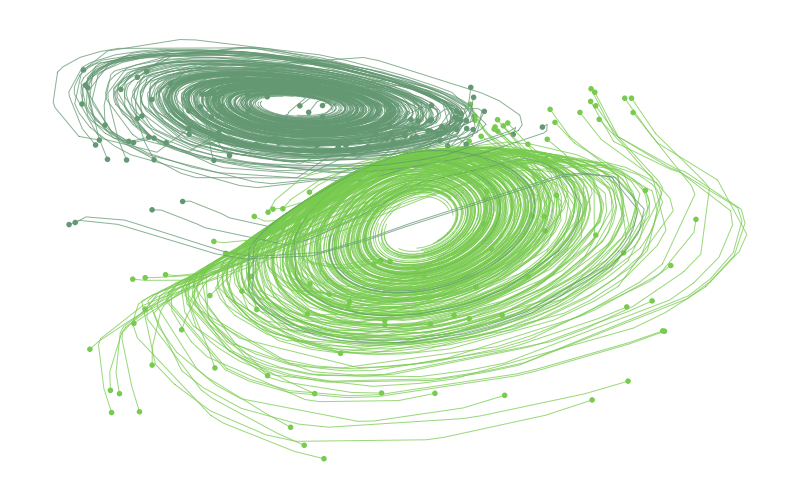
Neural Ordinary Differential Equations
Instead of specifying a discrete sequence of hidden layers, parameterize the derivative of the hidden state with a neural network and compute the output with a black-box ODE solver. These continuous-depth models have constant memory cost, adapt their evaluation strategy to each input, and can explicitly trade numerical precision for speed. We show how to backpropagate through any solver without access to its internals.
Neural Information Processing Systems (NeurIPS), 2018.
Oral. Best Paper Award.
* indicates equal contribution
Teaching
I have taught the following courses at University of Toronto:
- CSC412/2506: Probabilistic Learning and Reasoning (Winter 2020)
- STA414: Statistical Methods for Machine Learning II (Winter 2020)
- CSC412/2506: Probabilistic Learning and Reasoning (Winter 2019)
- CSC412/2506: Probabilistic Learning and Reasoning (Winter 2018)
In the past I have been a teaching assistant for the following courses:
- CSC2541: Generative AI for Images (Fall 2024)
- CSC411/2515: Introduction to Machine Learning (Fall 2018)
- CSC411/2515: Introduction to Machine Learning (Fall 2017)
- MAT136: Single Variable Calculus I for Science (Winter 2016)
- MAT186: Single Variable Calculus I for Engineering (Fall 2016)
- MAT235: Multivariable and Vector Calculus II for Science (Summer 2016)
- MAT235: Multivariable and Vector Calculus II for Science (Year 2016)
- ISCI2A18: Multivariable and Vector Calculus II for Integrated Science (Year 2014)
Past Projects
Ancient Egyptian Astronomy Database

Repository of information about astronomical documents from the pharaonic period of ancient Egypt.