Geoffrey E. Hinton
Department of Computer Science
| |
email: geoffrey [dot] hinton [at]
gmail [dot] com |
| University of Toronto |
|
voice: send email |
| 6 King's College Rd. |
|
fax: scan and send email |
| Toronto, Ontario |
|
|
| |
Information for prospective students:
I advise interns at Brain team Toronto.
I also advise some of the
residents in the
Google Brain Residents
Program.
I will not be taking any more students, postdocs or visitors at the University of Toronto.
News
Results of the 2012 competition to recognize 1000 different types of object
How George Dahl won the competition to predict the activity of potential drugs
How Vlad Mnih won the competition to predict job salaries from job advertisements
How Laurens van der Maaten won the competition to visualize a dataset of potential drugs
Using big data to make people vote against their own interests
A possible motive for making people vote against their own interests
Basic papers on deep learning
LeCun, Y., Bengio, Y. and Hinton, G. E. (2015)
Deep Learning
Nature, Vol. 521, pp 436-444.
[pdf]
Hinton, G. E., Osindero, S. and Teh, Y. (2006)
A fast learning algorithm for deep belief nets.
Neural Computation, 18, pp 1527-1554.
[pdf]
Movies of the neural network generating and recognizing digits
Hinton, G. E. and Salakhutdinov, R. R. (2006)
Reducing the dimensionality of data with neural networks.
Science, Vol. 313. no. 5786, pp. 504 - 507, 28 July 2006.
[
full paper ]
[
supporting online material (pdf) ]
[
Matlab code ]
Papers on deep learning without much math
Hinton, G. E. (2007)
To recognize shapes, first learn to generate images
In P. Cisek, T. Drew and J. Kalaska (Eds.)
Computational Neuroscience: Theoretical Insights into Brain Function.
Elsevier.
[pdf of final draft]
Hinton, G. E. (2007)
Learning Multiple Layers of Representation.
Trends in Cognitive Sciences, Vol. 11, pp 428-434.
[pdf]
Hinton, G. E. (2014)
Where do features come from?.
Cognitive Science, Vol. 38(6), pp 1078-1101.
[pdf]
Recent Papers
Hinton, G. E., Sabour, S. and Frosst, N.
Matrix Capsules with EM Routing
ICLR-2018
[pdf]
Kiros, J. R., Chan, W. and Hinton, G. E.
Illustrative Language Understanding: Large-Scale Visual Grounding with Image Search
ACL-2018
[pdf]
Anil, R., Pereyra, G., Passos, A., Ormandi, R., Dahl, G. and Hinton, G. E.
Large scale distributed neural network training through online distillation
ICLR-2018
[pdf]
Guan, M. Y., Gulshan, V., Dai, A. M. and Hinton, G. E.
Who Said What: Modeling Individual Labelers Improves Classification
AAAI-2018
[pdf]
Sabour, S., Frosst, N. and Hinton, G. E.
Dynamic Routing between Capsules
NIPS-2017,
[pdf]
Shazeer, N., Mirhoseini, A., Maziarz, K., Davis, A., Le, Q., Hinton,
G., & Dean, J. (2017)
Outrageously large neural networks: The
sparsely-gated mixture-of-experts layer
arXiv preprint arXiv:1701.06538
[pdf]
Ba, J. L., Hinton, G. E., Mnih, V., Leibo, J. Z. and Ionescu,
C. (2016)
Using Fast Weights to Attend to the Recent Past
NIPS-2016,
arXiv preprint arXiv:1610.06258v2
[pdf]
Ba, J. L., Kiros, J. R. and Hinton, G. E. (2016)
Layer normalization
Deep Learning Symposium, NIPS-2016,
arXiv preprint arXiv:1607.06450
[pdf]
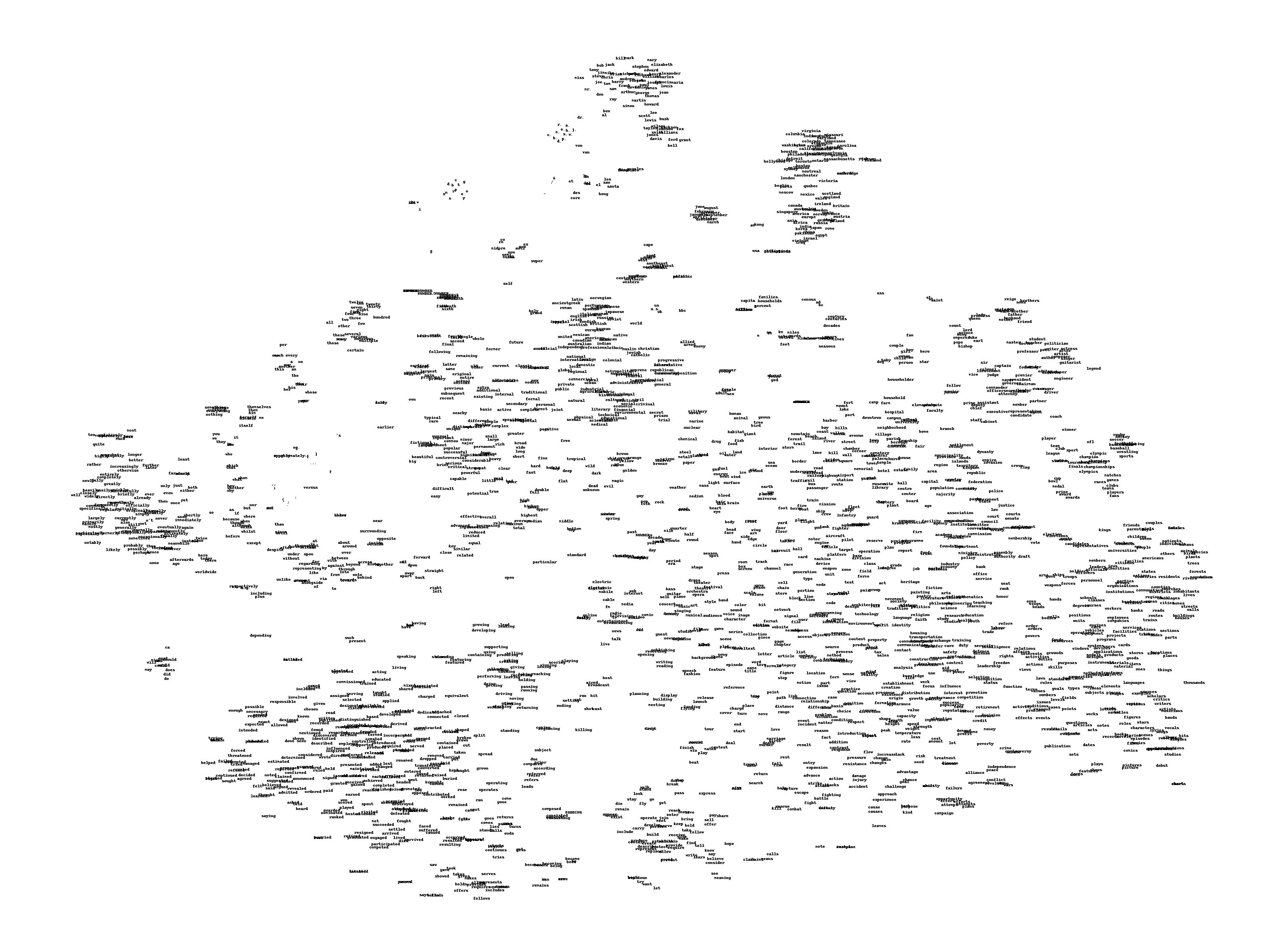
Joseph Turian's map of 2500 English words produced by using t-SNE on
the word feature vectors learned by Collobert & Weston, ICML 2008
   
Doing analogies by using vector algebra on word embeddings    
|