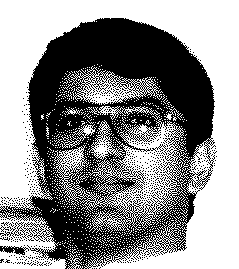
 Mark Moraes
Mark Moraes
Mark MoraesI'm presently heading up the engineering group for D. E. Shaw Research, a company doing scientific research in computational biochemistry and molecular dynamics. More about that...
In 2003, I co-founded Pointrex, Inc., purveyors of fine system management tools and best practices for Linux, Solaris and Windows. Didn't get past the self-funding stage...
From 2000 to 2003, I was CTO at Tapstone, Inc (formerly Teleias International Inc.) in Walnut Creek, California, building a neat appliance for server systems management in data centers.
In 1995, I was part of the original team that built Juno Online Services (first free dialup e-mail and then full Internet access) and was CTO there till 2000.
From 1992 to 1995, I worked for D. E. Shaw & Co., a New York City-based investment bank, designing and implementing systems infrastructure for a global trading network spanning Tokyo, London, Boston and New York.
I was the the first employee, programmer, sysadmin, customer support person, billing specialist and chief cook & bottlewasher at UUNET Canada and designed, built and supported most of the technology for its original product offering: UUCP feeds, e-mail and netnews as well as dialup and dedicated IP services.
Till 1991, I worked as a full-time systems programmer, setting up the
original cs.toronto.edu systems and networks for the CS
Department (AI/Numerical Analysis/Theory), creating a productivity
environment for the then-young X Window System (Versions 11R1-4). Some
of the programs I developed in this period (e.g. xpic, xtroff,
xplaces, xdrawmap, xplay, malloc, a set of cookbook examples for
Xt) can be found in either my CS ftp area or the general CS ftp area. (e.g.
programs I hacked on, modified or contributed to like track,
ypfake, dvix, host)
I came to University of Toronto for my M.A.Sc in Electrical Engineering which I finished in April 1990 (my thesis was a Hierarchical Design Rule Checker on MIMD multiprocessors, supervised by Martin Snelgrove). I also enjoyed part-time systems admin and programming for the Computer Systems Research Institute.
I got a B.Tech degree in Electrical Engineering at the Indian Institute of Technology, Delhi, 1982 - 1986
I was involved with Usenet for way too long; I was part of the original group-advice team and the moderator of news.announce.newusers for many years. The news.answers team has taken over moderation of news.announce.newusers.
I was UUCP Map Coordinator for Canada for several years (198x). Ed Hew now handles that.
John DiMarco has taken over further development of xcpustate. The current version can be obtained via anonymous ftp from his ftp area (ftp.cs.toronto.edu:/pub/jdd/xcpustate).
The latest version of Jove (Jonathan's Own Version of Emacs -- a small, fast, portable Emacs clone) can be found in my ftp area (ftp.cs.toronto.edu:/pub/moraes/jove). Questions about it should be directed to the jove–dev list hosted on cs•toronto•edu.
Other neat things in my ftp area are a program called ptouchlabel that uses ghostscript and a netpbm converter to print to a Brother P-Touch PC labeller, a fast secure unshar written entirely in C, and various little utilities that I hope to document fully one day. Many were written pre-Posix and may need some tweaking to work on modern systems.
Links to miscellaneous cool stuff
| Mark Moraes | Valid HTML 4.01 | Support Browser Diversity! | This work is licensed under a Creative Commons License. |