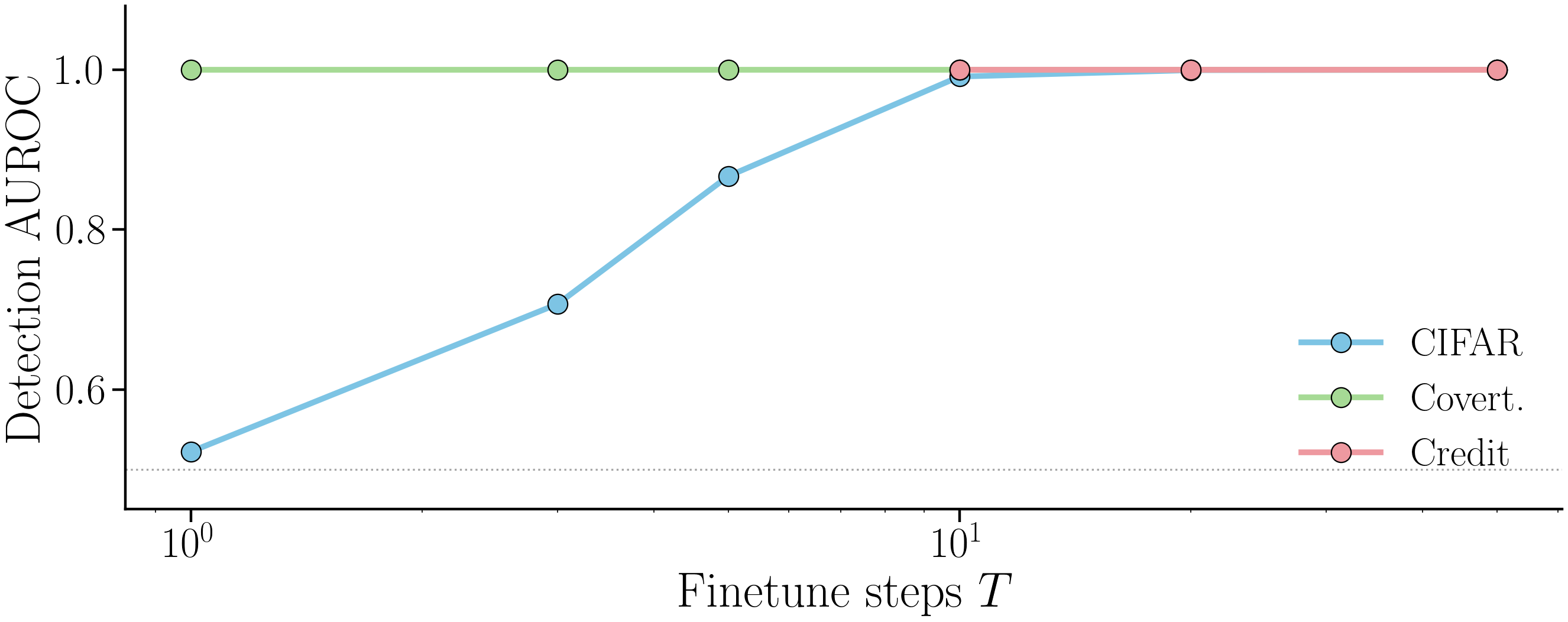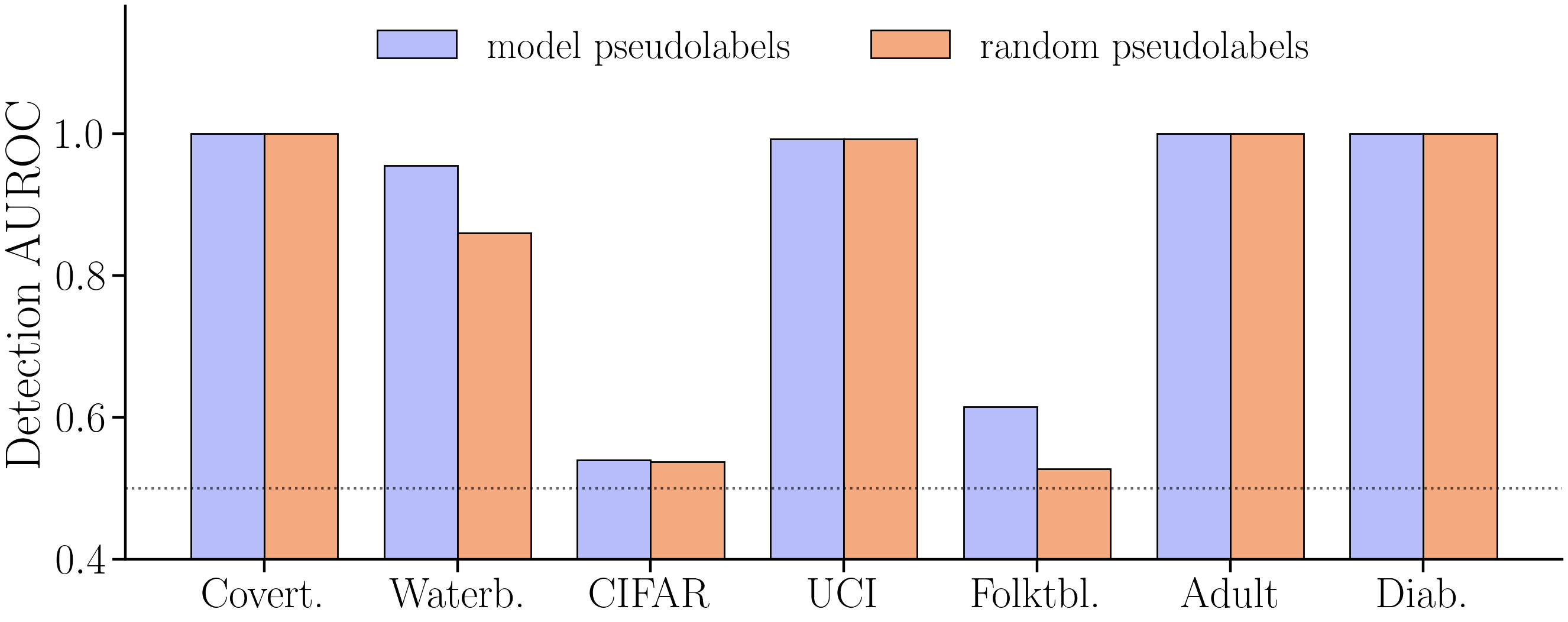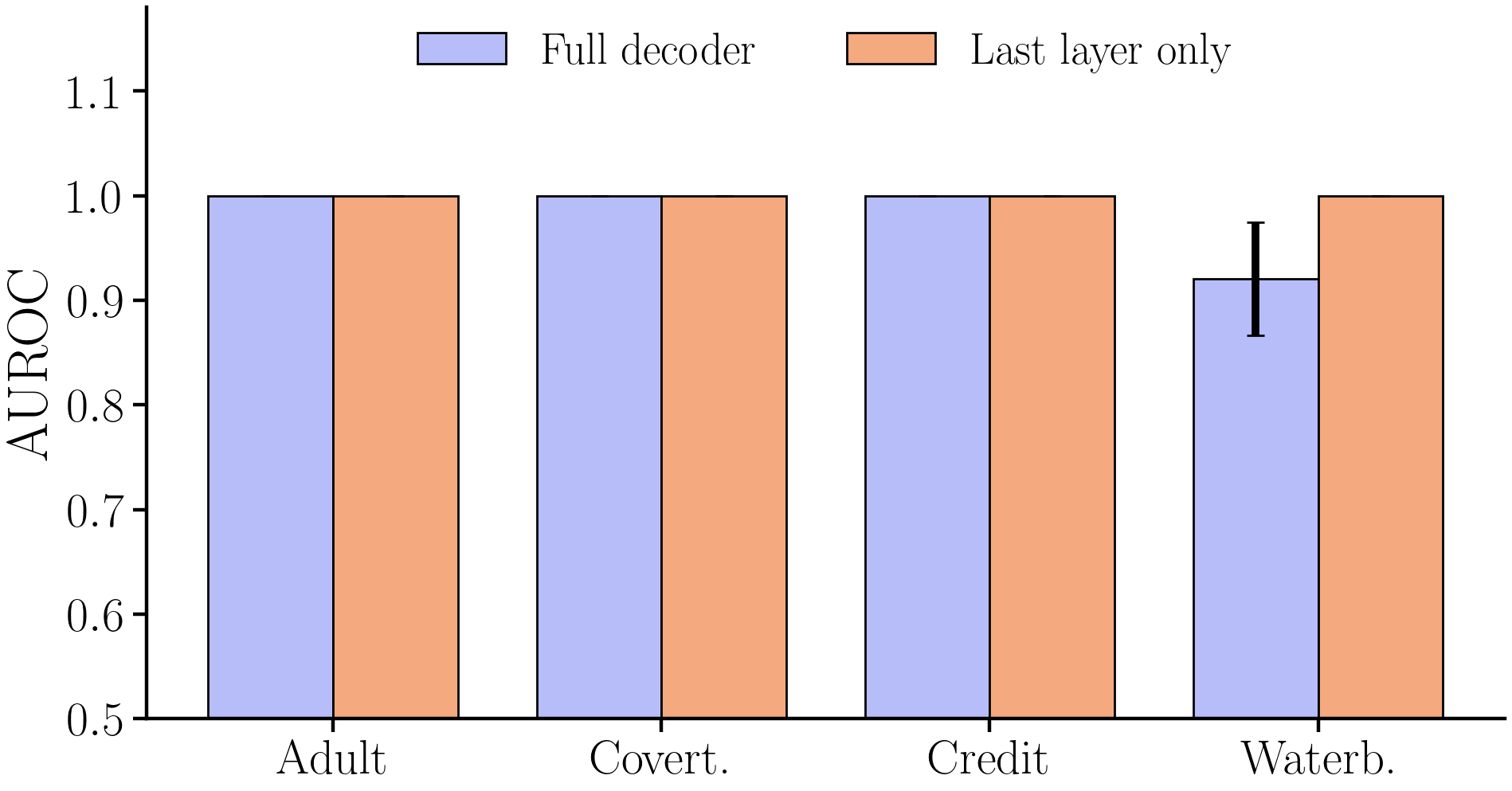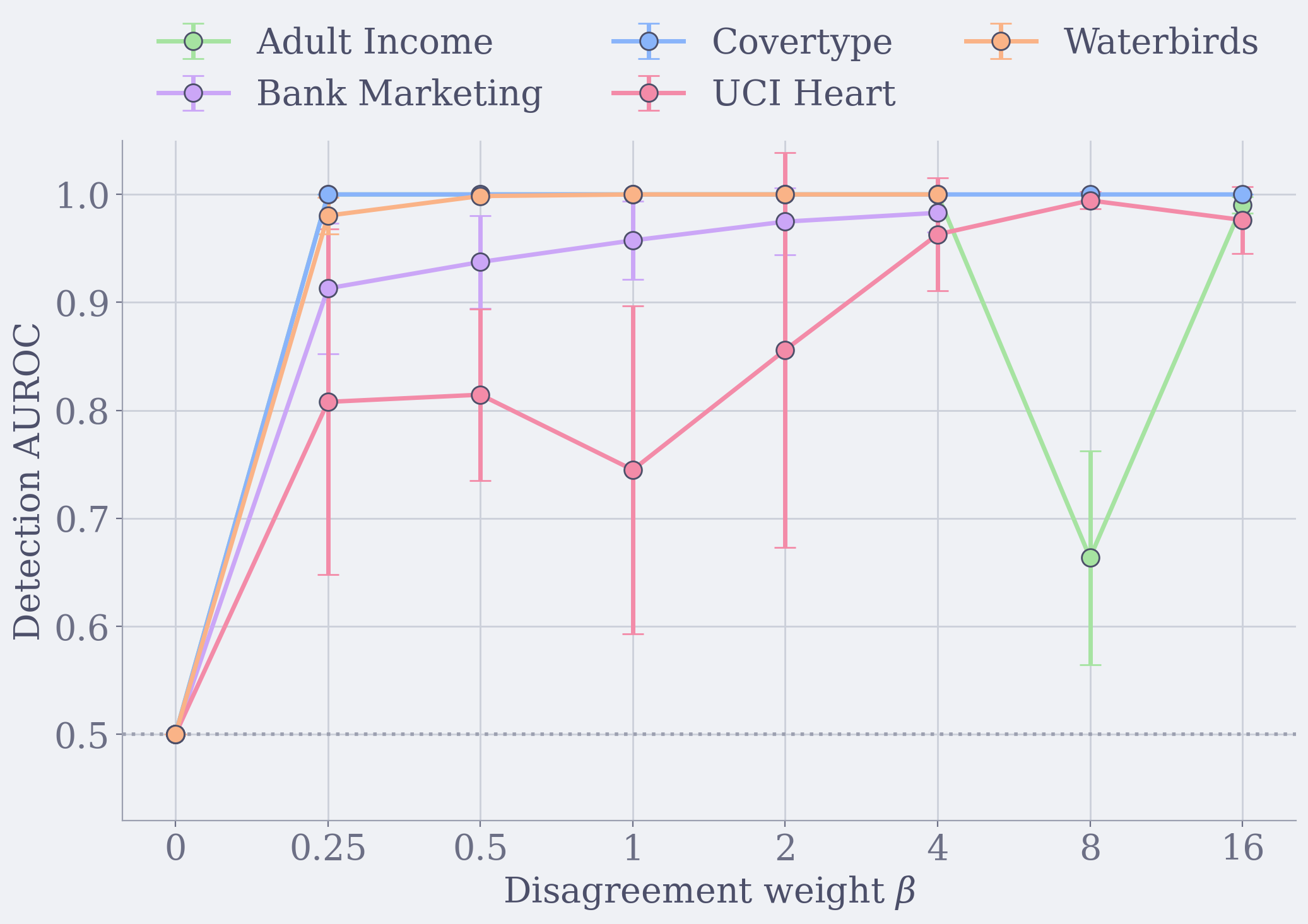
Tabular prior-fitted networks (PFNs) work well across tabular classification problems but can fail silently at deployment when distributions shift. We propose CALD (Calibrated Anchor-Loss Disagreement), a lightweight unsupervised monitor that triggers an alarm to warn when a PFN might fail. By finetuning the decoder to maximize disagreement with the test-set prediction while maintaining accuracy on an ID anchor set, CALD identifies harmful OOD batches through the resulting anchor loss, requiring no labels on test batches. We prove that the post-finetune anchor loss has a strictly lower expectation under sufficiently severe shift than under ID eval, yielding a one-sided test. Across 14 datasets covering tabular and structured distribution shift, on both TabPFN and TabICL, CALD matches or outperforms baselines on harmful shifts and is markedly more resilient to benign-shift false alarms.
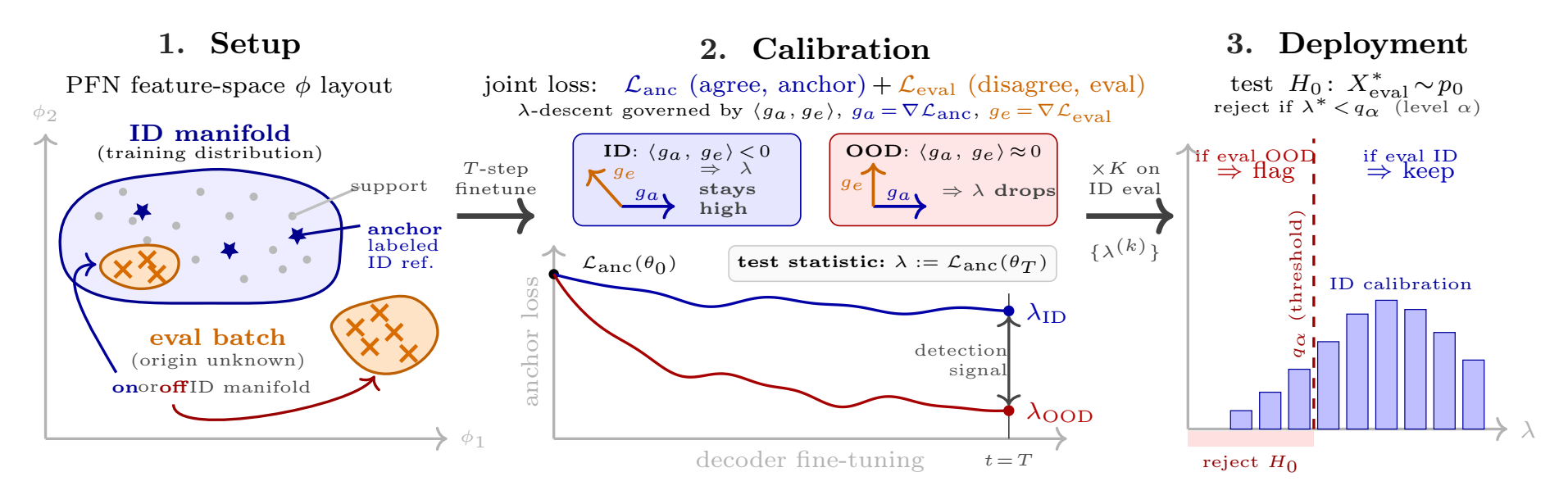
CALD gives the PFN a brief, deliberately conflicting exercise. Starting from the frozen pretrained model, it finetunes only the decoder under two forces: agree with the known labels of a small in-distribution anchor set, and disagree with its own pseudolabels on the unlabeled eval batch whose origin is unknown. The post-finetune anchor loss λ is the statistic.
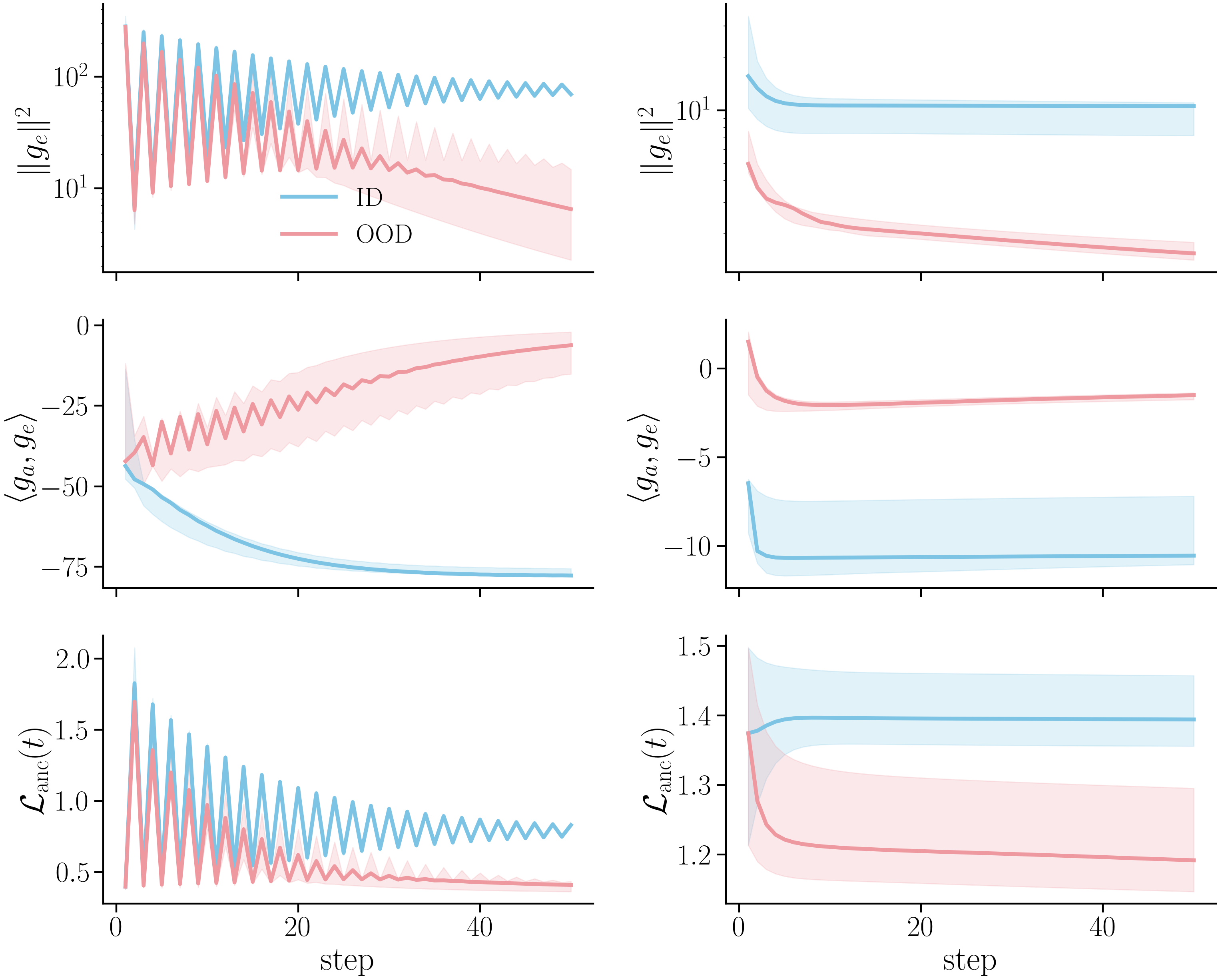
When the eval batch is in-distribution, the disagreement gradient fights the anchor gradient and the anchor loss stays high. When the eval batch has shifted, the two gradients decouple, the anchor descends freely, and λ falls. Comparing the deployment value of λ against a calibration record of in-distribution runs turns this into a one-sided test with a controlled false-alarm rate. No labels on the deployment batch are needed.
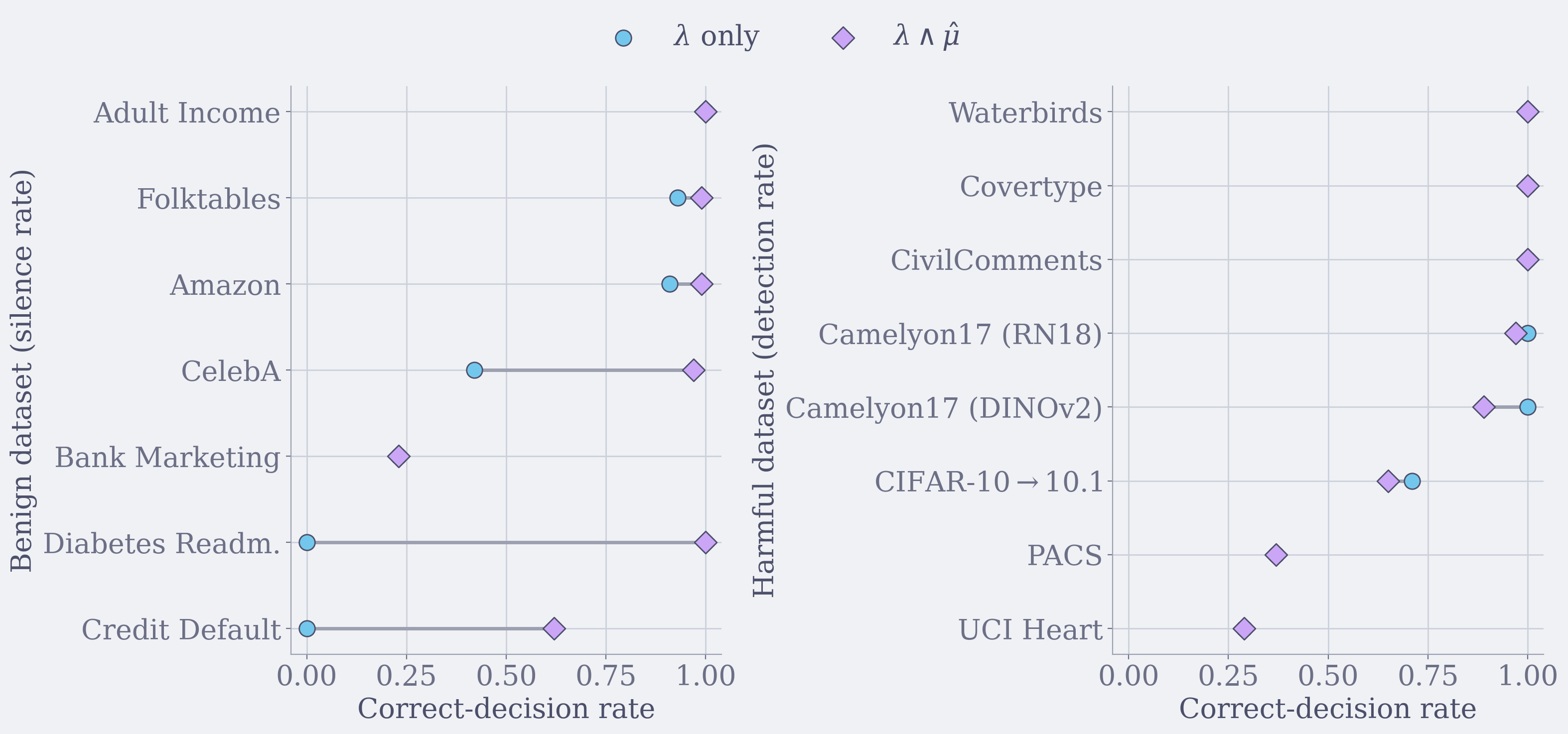
True-positive rate at 5% false-positive rate across 14 shifts, ordered by the accuracy drop Δ the shift inflicts. For harmful shifts the metric is the alarm rate; for benign shifts it is the correct-silence rate. Bold marks the best method per column. Label-blind detectors such as D-MMD, H-divergence and KNN alarm on nearly everything, harmful or not; CALD keeps most of the harmful-side power while staying quiet on most benign shifts.
| Benign (Δ ≤ 4.8%) | Harmful (Δ > 4.8%) | |||||||||||||
|---|---|---|---|---|---|---|---|---|---|---|---|---|---|---|
| Method | Adult | Diab. | Amazon | Credit | Folktbl. | Bank | CelebA | CivilC. | Camel. | Waterb. | CIFAR | UCI | PACS | Covert. |
| Δ (pp) | -9.4 | -2.3 | +1.5 | +2.8 | +3.1 | +4.4 | +4.5 | +7.4 | +8.9 | +11.6 | +12.4 | +15.6 | +27.9 | +83.5 |
| MSP | .00 | .64 | .78 | .55 | .53 | .00 | .63 | 1.00 | .97 | 1.00 | .96 | .74 | 1.00 | 1.00 |
| Entropy | .00 | .61 | .80 | .61 | .50 | .00 | .39 | 1.00 | .98 | 1.00 | .97 | .77 | 1.00 | 1.00 |
| Energy | .00 | .00 | .77 | .00 | .86 | .42 | .04 | 1.00 | 1.00 | 1.00 | .97 | .66 | 1.00 | .50 |
| Mahal. | .00 | .00 | .71 | .00 | .12 | .05 | .00 | .32 | .43 | .18 | .55 | 1.00 | 1.00 | 1.00 |
| RMD | .69 | .59 | .87 | .92 | .72 | .05 | .42 | .51 | .40 | .52 | .67 | .47 | 1.00 | 1.00 |
| KNN | .00 | .00 | .78 | .00 | .23 | .00 | .00 | 1.00 | .95 | .97 | .10 | .99 | 1.00 | 1.00 |
| ViM | .00 | .10 | .87 | .00 | .63 | .13 | .81 | .23 | .54 | .18 | .15 | .93 | .70 | 1.00 |
| BBSD-S | .00 | .40 | .75 | .76 | .71 | .02 | .64 | .61 | .94 | .88 | .89 | .81 | 1.00 | 1.00 |
| BBSD-E | .00 | .00 | .76 | .67 | .66 | .00 | .49 | .58 | 1.00 | .99 | .72 | 1.00 | 1.00 | 1.00 |
| D-MMD | .00 | .00 | .66 | .00 | .00 | .00 | .54 | .91 | 1.00 | 1.00 | .68 | 1.00 | 1.00 | 1.00 |
| H-Div | .00 | .00 | .19 | .00 | .10 | .32 | .00 | .70 | 1.00 | 1.00 | .50 | 1.00 | 1.00 | 1.00 |
| GradNorm | .00 | .44 | .85 | .01 | .78 | .27 | .60 | 1.00 | .92 | .98 | .91 | .54 | .98 | .70 |
| GradOrth | .83 | .77 | .83 | .69 | .86 | .02 | .46 | .66 | .54 | 1.00 | .95 | .23 | .97 | 1.00 |
| GAIA-z | .00 | .07 | — | .01 | .80 | .29 | — | — | — | — | — | .41 | — | .59 |
| WeiPer | .18 | .17 | .89 | .00 | .67 | .17 | .81 | .34 | .45 | .26 | .21 | .89 | .62 | .73 |
| Cald (TabPFN) | 1.00 | .08 | .92 | .00 | .98 | .02 | .27 | 1.00 | .19 | .46 | 1.00 | .71 | 1.00 | 1.00 |
| Cald (TabICL) | 1.00 | .00 | .87 | .76 | .42 | .00 | .97 | .99 | 1.00 | .99 | .99 | .71 | 1.00 | 1.00 |
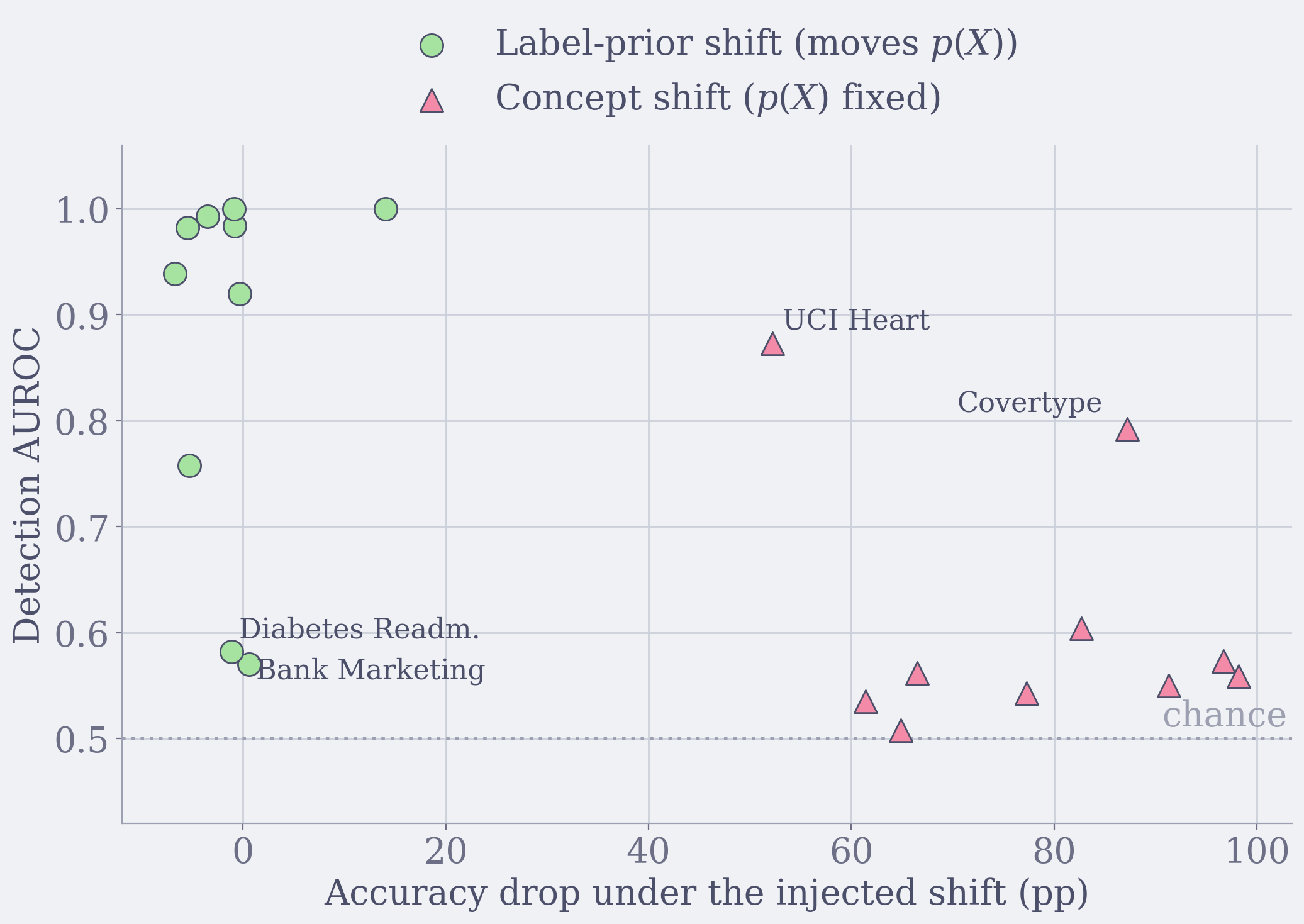
A deterioration monitor is only useful if its alarm scales with the harm a shift inflicts rather than with how novel the shifted inputs look. We sweep shift severity on a controlled 2D Gaussian, where rotating the class boundary is harmful and translating the inputs is benign, and on Waterbirds, where the fraction of spuriously-correlated minority samples sets the accuracy drop.
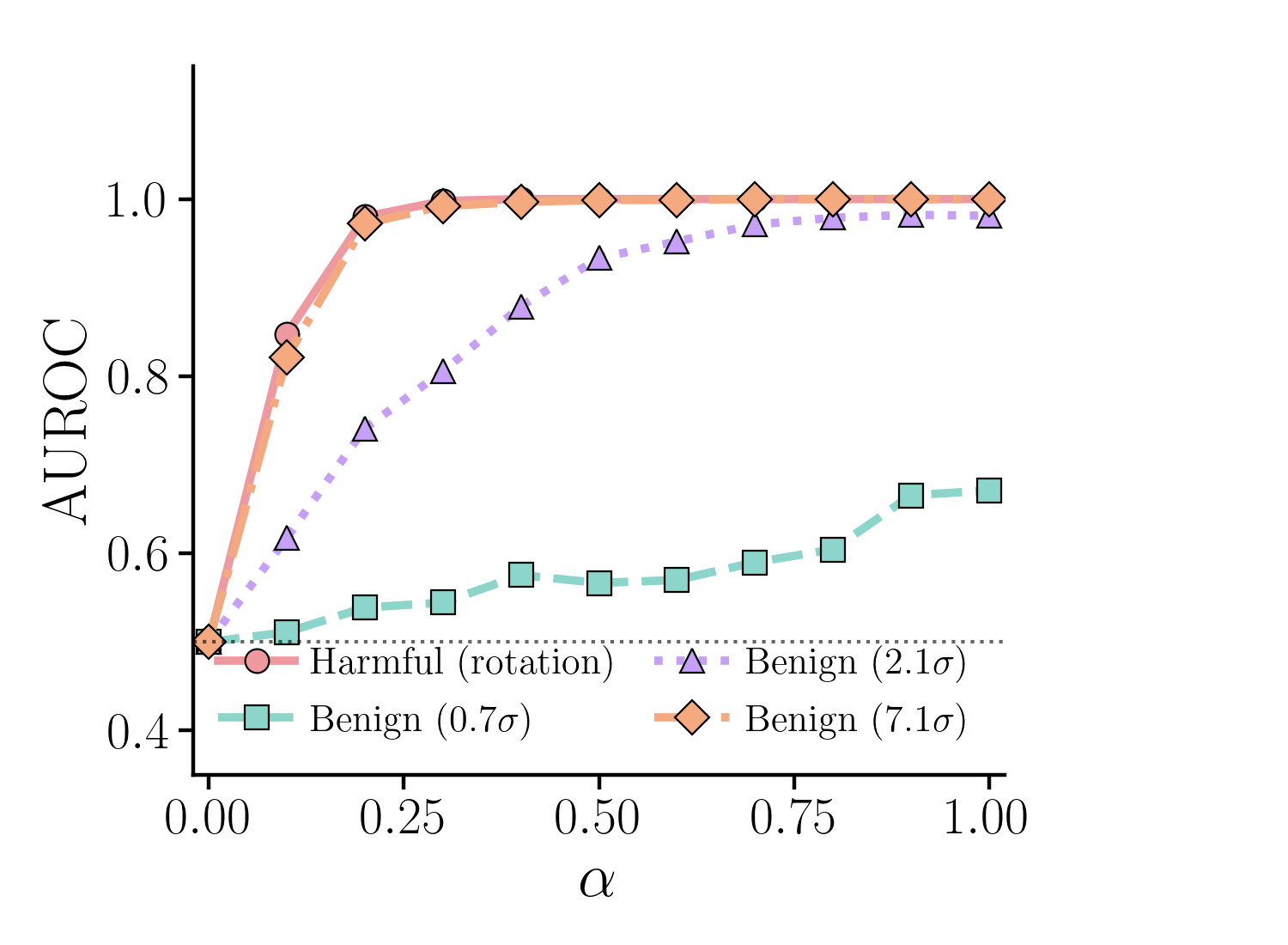
Synthetic 2D Gaussian.
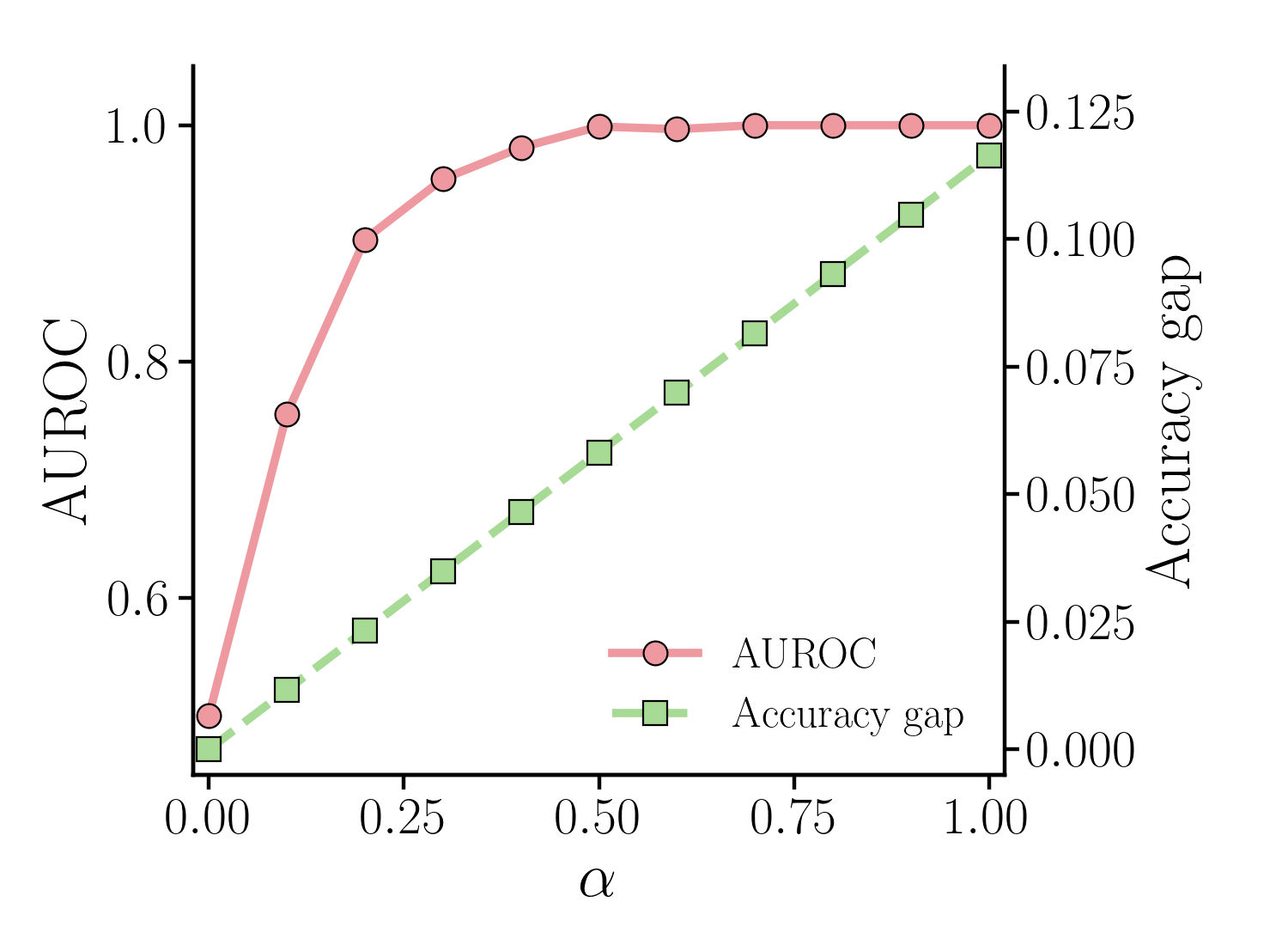
Real (Waterbirds, minority-fraction sweep).
AUROC sits at chance with no shift, rises monotonically with the accuracy gap, and saturates at the most severe setting. On the benign axis, a small translation stays near chance throughout, while larger translations fire: a feature-space monitor cannot be perfectly harm-calibrated, and the paper's theory says why.
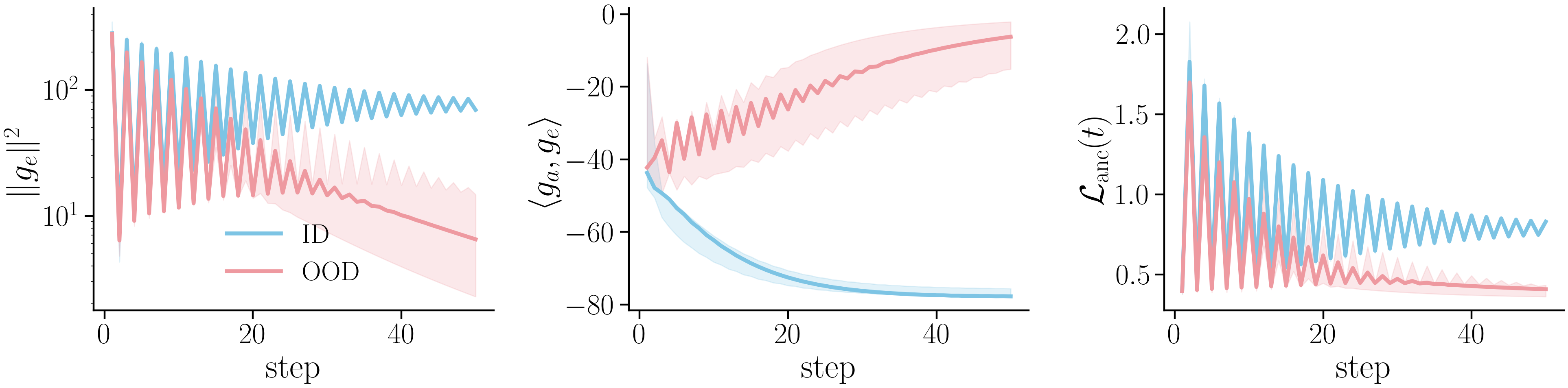
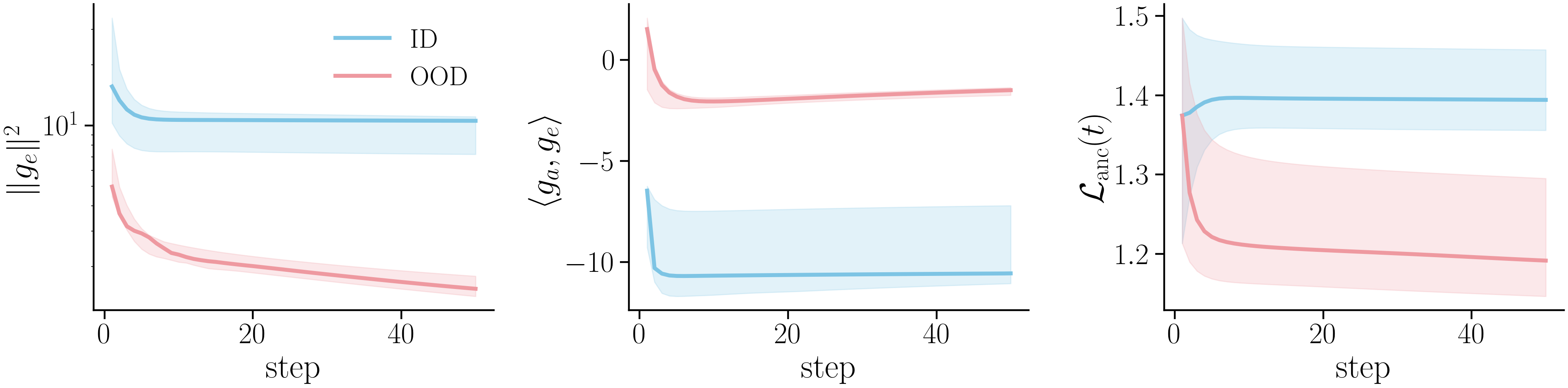
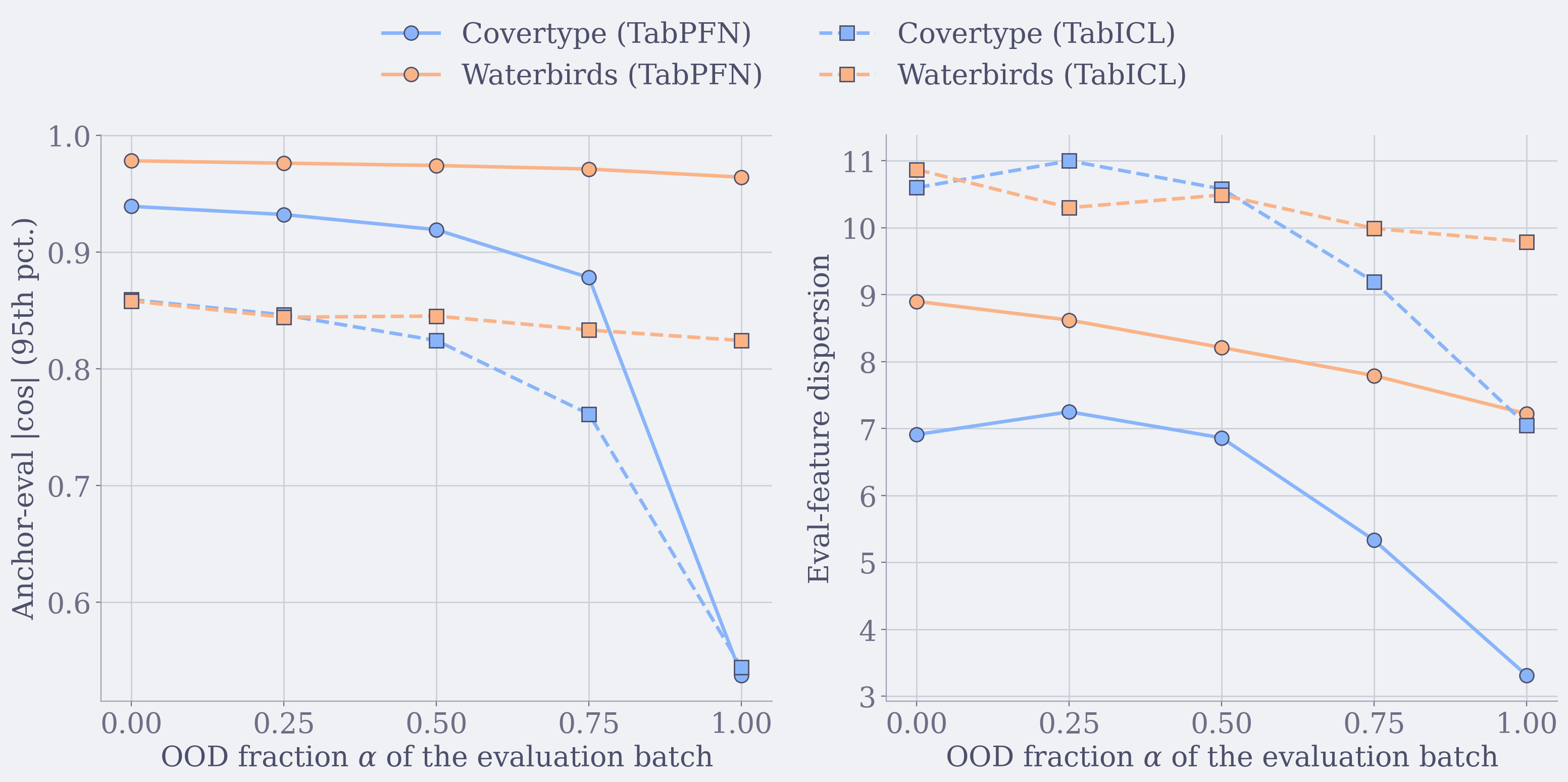
The theory rests on one quantity: the inner product ⟨ga, ge⟩ between the anchor-agreement and eval-disagreement gradients. To first order, the anchor loss descends at its vanilla rate corrected by this cross-term. Two things must hold for the mechanism to be real: the cross-term must govern anchor descent step by step, and its value must differ between in-distribution and shifted eval batches.
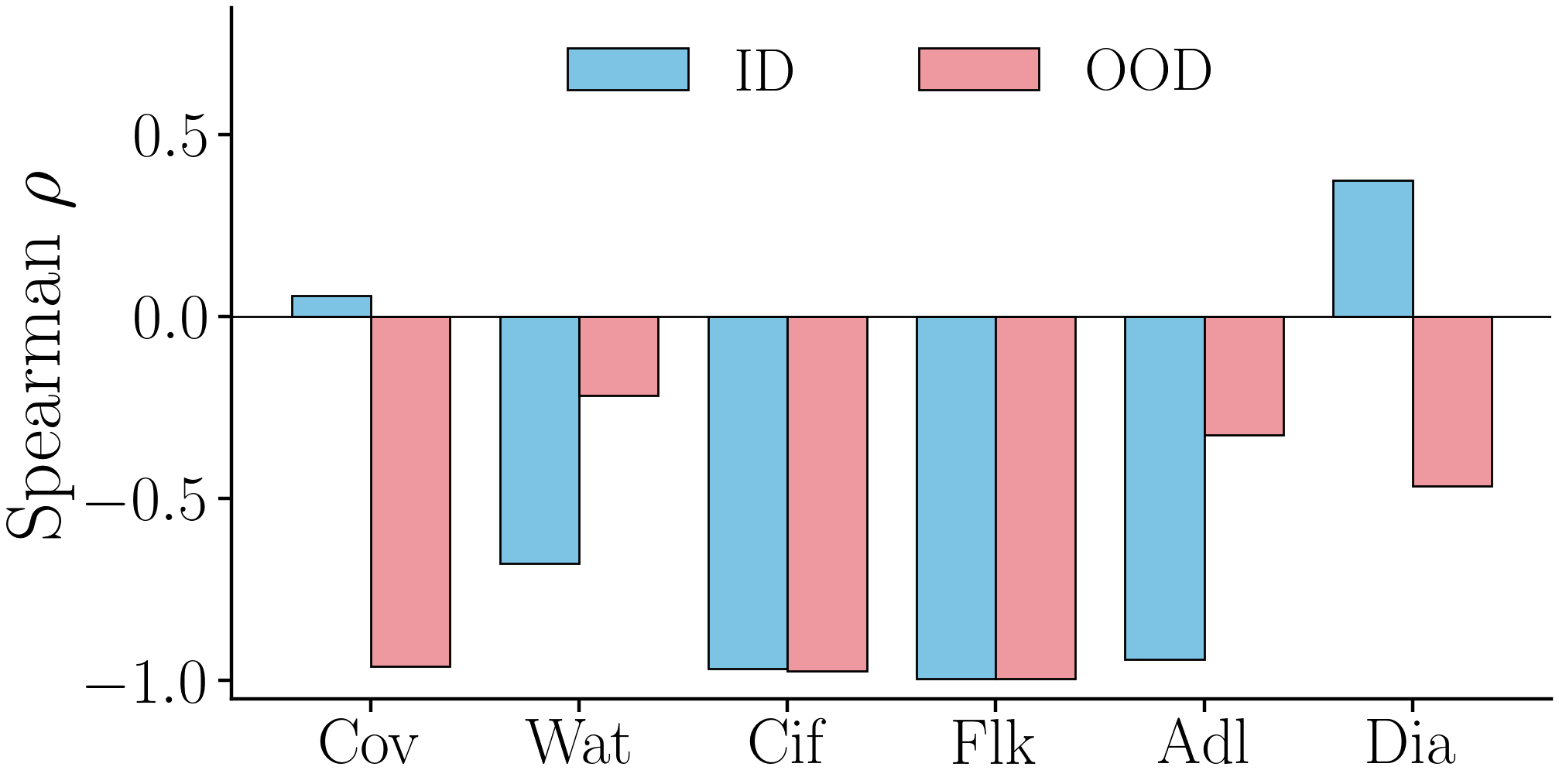
(a) Per-step Spearman ρ between cos(ga, ge) and the anchor-loss change, ID vs. OOD. Negative ρ is the first-order prediction.
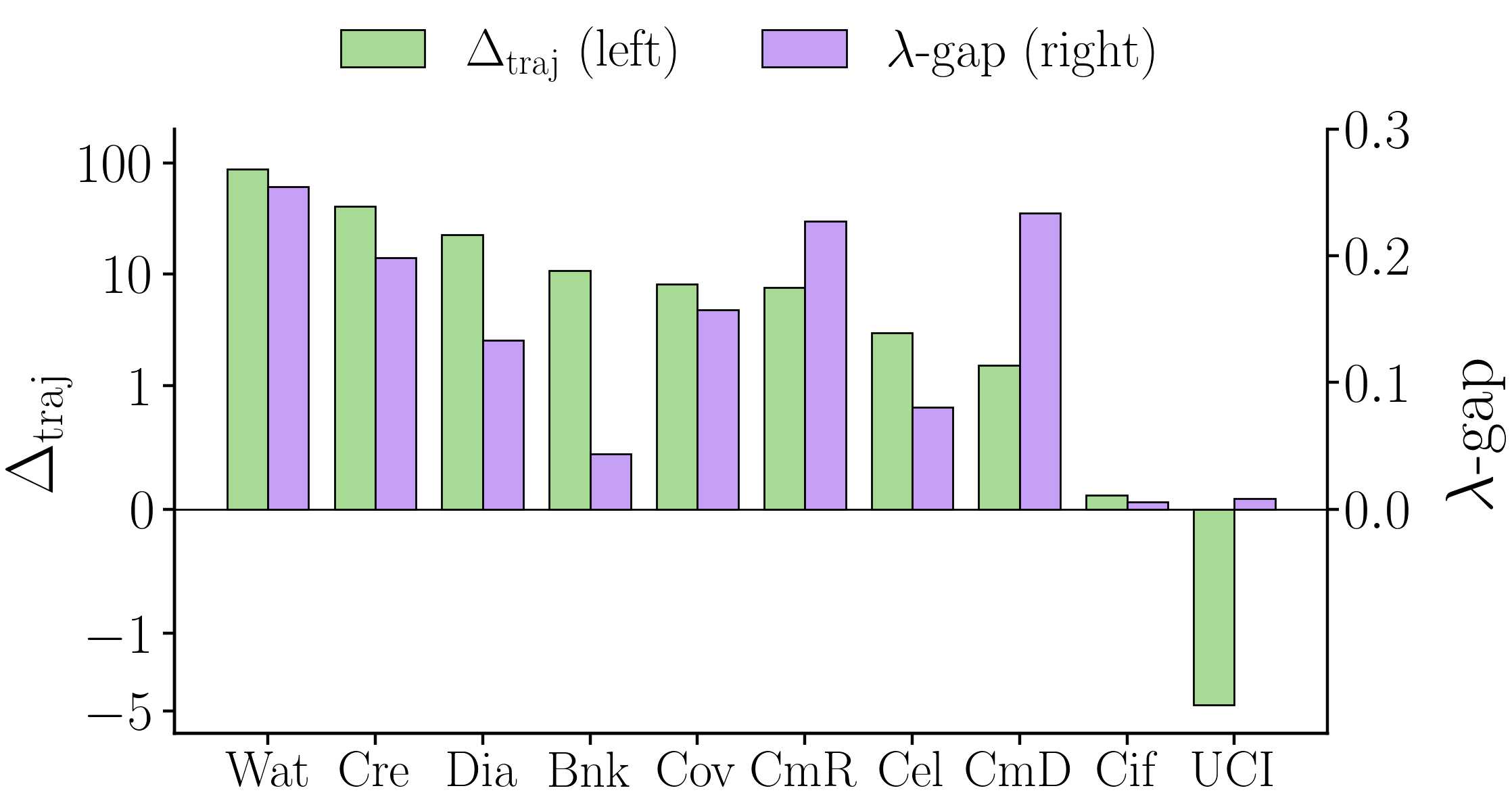
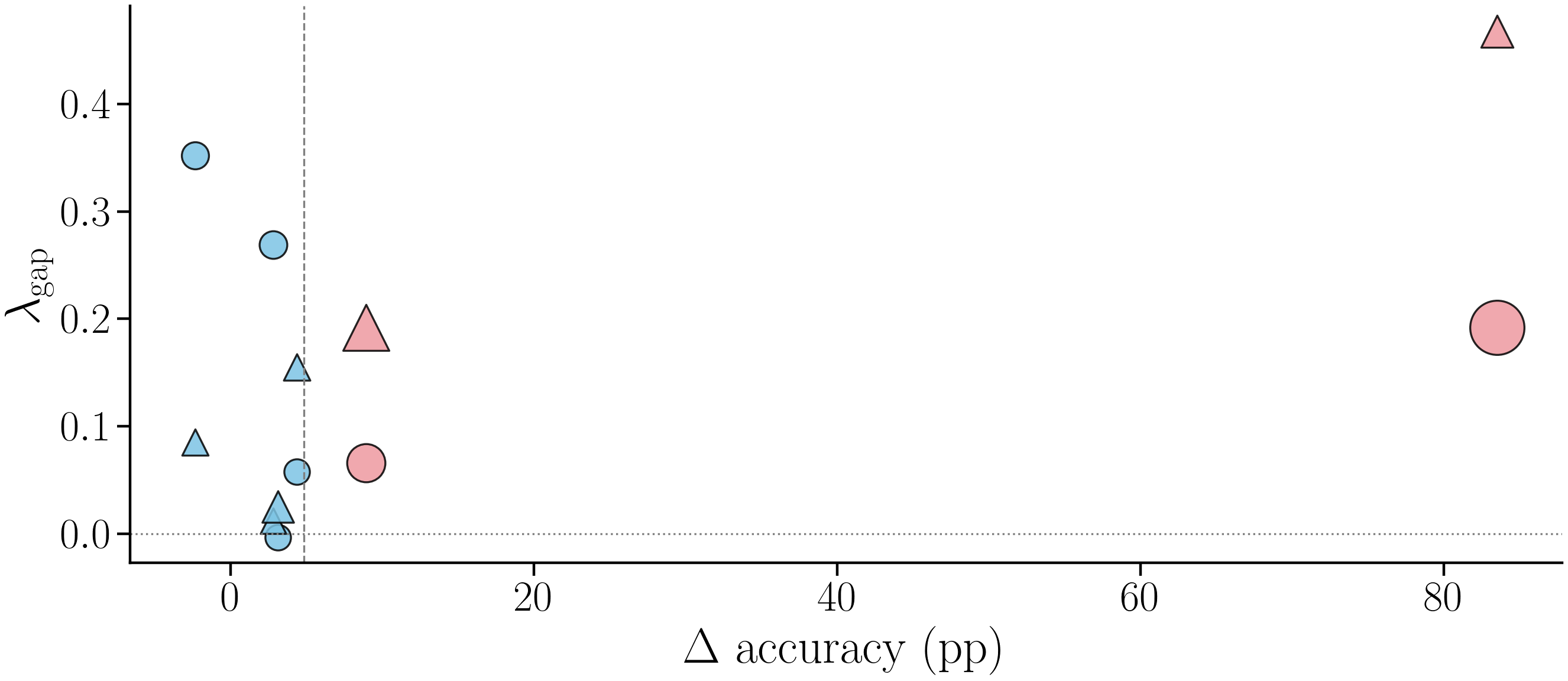
(b) The proof's premise Δtraj (left axis) and the λ-gap it produces (right axis), per dataset.
The first-order law holds in both regimes (a), so it is not what separates them. The separation comes from the value of the cross-term: the ID/OOD gap Δtraj is positive on nine of ten datasets (b), and the two datasets where it is weakest, CIFAR-10 and UCI Heart, are exactly the two with a near-zero λ-gap. The measurement predicts the detector's weakest cells in advance.
Theory, scope, experimental details and the full ablation suite, in the order of the paper.
@inproceedings{nguyen2026cald,
  title     = {When to Trust a PFN: Detecting Harmful Shift in Tabular Foundation Models},
  author    = {Nguyen, Viet and Bergstr{\"o}m, Herman and Rabanser, Stephan and Krishnan, Rahul G.},
  booktitle = {Advances in Neural Information Processing Systems (NeurIPS)},
  year      = {2026}
}