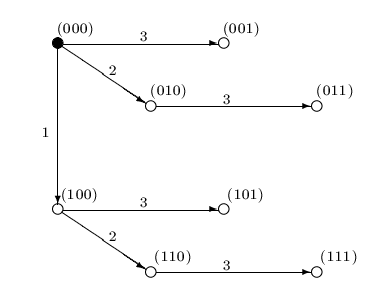
Broadcast scheme for Q3 with 000
as originator.

Hypercubes were the first infinite class of minimum broadcast graphs to be discovered. The hypercube Qk has 2k vertices. Farley et al. proved that B(2k) = k·2k-1 in [4].
To show that B(2k) ³k·2k-1, observe that every vertex in a minimum broadcast graph on 2k vertices must have degree greater than or equal to k in order to call all 2k vertices in k time units. Since S"uÎV(G)deg(u) = 2e, where e is the number of edges in G, B(2k) ³ k·2k-1.
We can show that B(2k) £k·2k-1 by constructing a broadcast graph on 2k vertices with k·2k-1 edges. This can be done by adding a matching involving 2k-1 edges to the union of two graphs on 2k-1 vertices. This can be done inductively, starting with the minimum broadcast graph on 1 vertex.
Hypercubes satisfy the
above
conditions. To describe the hypercube broadcast scheme, assign k-bit
binary labels 000...0 through 111...1 to the 2k
vertices
of Qk. Let u, v Î
V(Qk). u is adjacent
to v iff the ith bit of u is different from the
ith
bit of v, and all other bits in their labels match. u
and
v are then called ith-dimensional neighbours. Broadcasting
is accomplished as follows: at time i, 1 £
i £ k, all
informed
vertices broadcast to their ith-dimensional neighbours.
Broadcast scheme for Q3 with 000
as originator.