- Apply the following image mask to image 2 2 3 4 7 3. Apply Ml at the left and Mr at the right.
Ml=2/3 1/3
M=1/4 2/4 1/4
Mr=1/3 2/3
- Write down a sparse quad tree representation for the following image.
In this case, label a node if all leaves below it have the same pixel value.
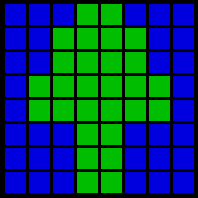
- Given the Haar wavelet representation of an image, compute the image.
Do the reverse (for example, for the above image, compute its Haar wavelet
representation).
- Show that given composite color (r,g,b) and background color (r',g',b')
you can not in general compute the foreground pixel (r0,g0,b0,alpha0).
- Explain two ways the above matting problem can be restricted so that it can be solved.
- Write a simple, efficient algorithm which draws a line with slope 2/3
starting at point (x,y) within image coordinates and stops at the image boundary.
The image has width w and height h and origin at the bottom left. You can plot a few points beyond the boundary.
- Consider the following mask
0 0 0
-1 0 1
0 0 0
What can it be used for? Explain how to use it. What is it an approximation for?
- Explain why we use the LoG for edge detection? Can a Gaussian be used for edge detection?
Can a Laplacian be used?
- Describe how you can give an image a painterly effect. What does this have to do with edge detection?
- True or false: The following is a good example of a Gaussian mask. Explain.
1/9 1/9 1/9
1/9 1/9 1/9
1/9 1/9 1/9
- Explain the intelligent scissors paper.
- The following is a Haar Wavelet representation of an image. Compute the original image.
5 1
3 7
- Explain what is meant by Haar is an invertible, but not in practice.
- Find n such that, I=Haar-1(Haar(I * 2n))/2n if only integer arithmetic is allowed (with large integers).
- Do test 1, Bresenham's algorithm, definitions, triangulation matting, bi-linear interpolation ...
- Image gradient, what is it, how do you calculate it,
given a image, calculate the gradient at a point,
calculate the gradient magnitude, gradient orientation
- Derive a 1D mask approximating the first derivative
- Show how to derive a 1D mask approximating the second derivative
Hint: use f'(x) is almost (f(x+h/2)-f(x-h/2))/h then do it again
- How do you detect an edge using the first derivative, second derivative,
Laplacian?
- Explain how you compute a Gaussian mask given sigma. Do the same for
a LoG mask.
- Explain how you compute a Laplacian pyramid of an image.
- Compute the Fourier transform of a simple signal (do the example
in the week 05 lecture notes).
- Answer Kira's question, why does the sun seem to stay still and the
trees move?
- Given a set of points in 3 space, compute the perspective transform of
the points (ie onto the plane z=1). Compute the orthographic projection of these points.
- Explain how, given 2 quadrilaterals you map one onto the other using
a projective 2D linear map (ie start with page 8 of the week 7 lecture notes
and describe the linear system that arises, where do the 8 equations and 8 unknowns come from).