About
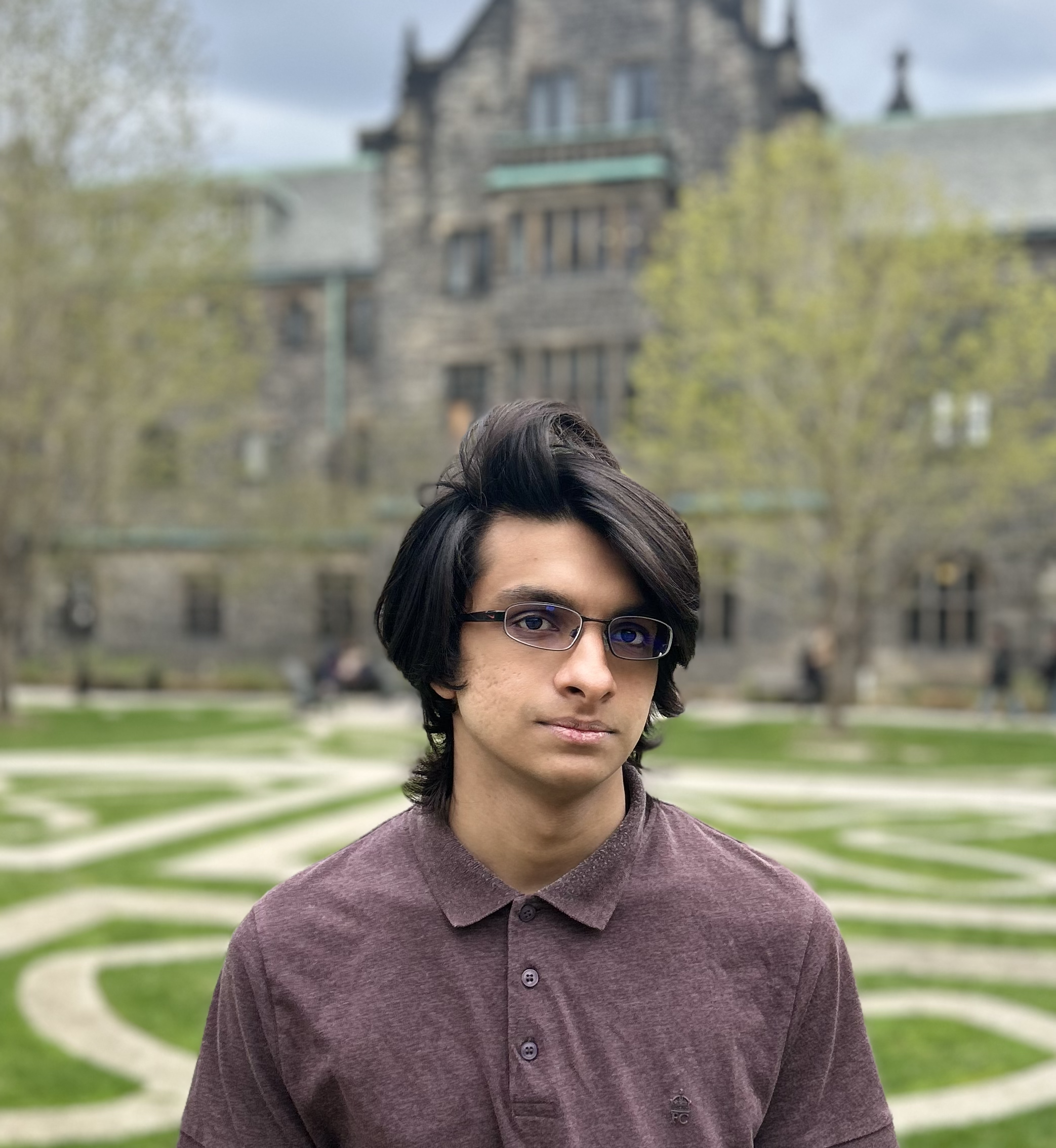
I am a fourth-year math and CS undergrad at the University of Toronto. I am extremely fortunate to be supervised by Professor Allan Borodin, working on online algorithms and competitive analysis. I have also been fortunate to work with Professor Shubhangi Saraf on algebraic complexity theory. I will also be working with Professor Uma Girish on quantum complexity theory in Winter 2027. Broadly speaking, my research interests lie in theoretical computer science and quantum computing: specifically computational complexity theory, algorithms, and their quantum analogues.
Research
-
A Potential Function Analysis of Double Coverage for the k-Taxi Problem on Trees
Preprint (arXiv) · Supervised by Prof. Allan Borodin
We provide potential function proofs of the competitive ratios of Double Coverage for the hard k-taxi problem on HSTs and general weighted trees of bounded depth. Buchbinder, Coester, and Naor [BCN23] obtained these ratios using time-reverse dual fitting and noted that they did not know a pure potential proof beyond k = 2.
We observe that the minimum matching distance between the online and offline taxi configurations can be expressed as an integral over the rooted tree of the absolute difference between their taxi counts below each point. This representation lets us analyse Double Coverage over short movement intervals and apply the resulting estimates to potentials that remain unchanged when both serving taxis are relocated from pickup to destination.
-
Tensor Rank Upper Bounds for Algebraically-Defined Tensors
Preprint (PDF) · Supervised by Prof. Shubhangi Saraf
We resolve an open question posed in Appendix D of Alexeev, Forbes, and Tsimerman [AFT11] regarding the tensor rank upper bound of a family of algebraically-defined tensors. We first prove the equality between the tensor rank of this particular family and the bilinear complexity of polynomial multiplication in a quotient ring. Using known bounds on bilinear complexity, the tight upper bounds on the rank follow immediately. For completeness and expository purposes, we demonstrate three distinct arguments to bound the bilinear complexity and thus the rank: interpolation, recursive reduction, and finally, the optimal linear upper bound of O(n) is achieved by using the algebraic curve method of Chudnovsky and Chudnovsky. Matching the linear lower bound of Alexeev et al., this implies the tensor rank of this family is Θ(n).
-
Computational Knot Theory and the Theta Invariant
PDF (Report) · Wolfram Community Post · Supervised by Prof. Dror Bar-Natan
Explores the theta invariant, a powerful, genuinely-computable knot invariant developed by Dror Bar-Natan and Roland van der Veen (featured in Quanta Magazine). Calculated this invariant across several families of knots, including torus, pretzel, and twisted torus knots, to investigate its properties.
Expository Writing & Reports
-
The BLR Linearity Test
Scribe Notes (PDF) · Mathematical Methods in TCS: Boolean Functions (Fall 2026)
Scribe notes on the BLR linearity test and its proof using Fourier analysis.
-
Tensor Rank and Lower Bounds for Arithmetic Formulas
Write-up (PDF) · Slides (PDF) · CSC2429 Expository Project
Expository write-up and presentation slides for the graduate course CSC2429H (Topics in the Theory of Computation: Algebraic Complexity), taught by Prof. Shubhangi Saraf. The work focuses on Ran Raz's breakthrough paper [Raz10], exploring how strong lower bounds for tensor rank yield super-polynomial lower bounds for general arithmetic formulas.
Contact
Feel free to reach out via email.